
In Trepidation, Karen Thomas gives a performance that feels deeply authentic, emotionally layered, and remarkably relatable. As Anna, she captures the fragile emotional state of someone struggling with heartbreak, isolation, and social anxiety with a level of sincerity that quietly stays with the audience long after the film ends.
What makes Karen Thomas’s performance truly stand out is how naturally she expresses emotion without relying on exaggerated dramatics. From the very first moments of the film, the audience can sense Anna’s loneliness simply through her body language, facial expressions, and silence. Sitting alone watching disturbing crime documentaries late at night, Anna immediately feels like someone emotionally withdrawn from the world around her. Karen Thomas portrays this emotional exhaustion with subtle precision, making the character feel incredibly human.
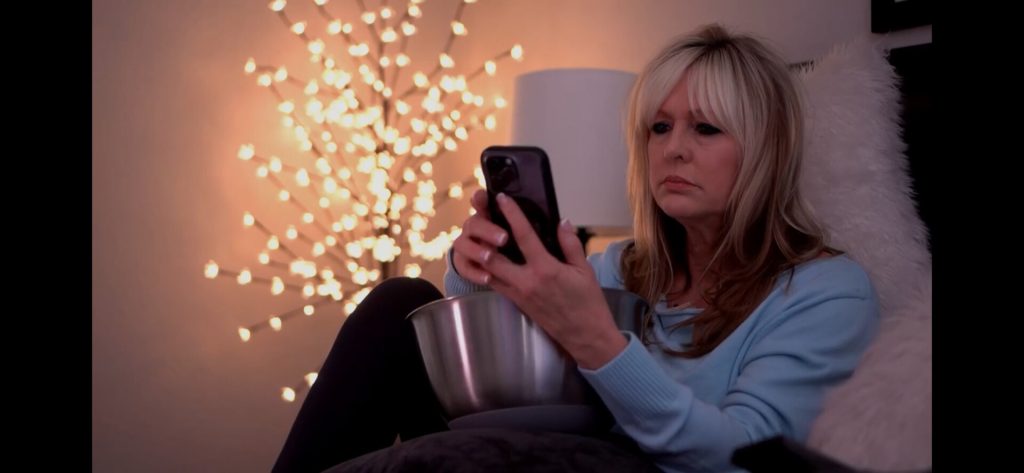
One of the strongest aspects of her performance is the way she handles anxiety and emotional discomfort throughout the story. After her breakup, Anna clearly wants to avoid social interaction and public gatherings altogether. Karen Thomas beautifully reflects the mindset of someone who no longer feels emotionally ready to face people, conversations, or forced happiness. The hesitation in her expressions, the awkward pauses, and the visible discomfort she carries while approaching the Christmas party all make the audience genuinely empathize with her situation.
The party sequence especially showcases her acting strength. As Anna stands outside, reluctant to enter, Karen Thomas perfectly communicates the internal battle between wanting to retreat into solitude and trying to push herself back into normal social life. The scenes where Anna imagines the people around her behaving in exaggerated, almost surreal ways brilliantly represent her anxious perspective, and Karen’s reactions during these moments make the audience experience that discomfort alongside her.
What is most impressive is how gradually and realistically the character evolves within such a short runtime. Anna does not suddenly transform into a completely different person. Instead, Karen Thomas allows the character to slowly open herself back up to human connection. Through her interactions with Katie and later conversations at the party, the audience can see tiny shifts in Anna’s emotional state — from fear and withdrawal to cautious participation and emotional acceptance. That emotional progression feels organic because of how carefully Karen Thomas controls each scene.
Her chemistry with Pam Rineal, who plays Katie, also deserves praise. Together, they create a believable friendship dynamic filled with warmth, care, and emotional support. Katie’s encouragement only works because Karen Thomas gives Anna such believable vulnerability in return. Their scenes together become the emotional heart of the film.
Karen Thomas’s performance succeeds because it understands that emotional pain is often quiet rather than loud. Instead of overplaying sadness, she portrays the small emotional details — the avoidance, the discomfort, the nervousness, and eventually the willingness to reconnect with people again. Those details are what make Anna such a compelling character.
For a short film with a limited runtime, creating an emotionally memorable protagonist is not easy. Yet Karen Thomas manages to make Anna feel complete, relatable, and deeply real. Her performance carries the emotional soul of Trepidation and proves her ability to communicate complex feelings with subtlety and grace.
Congratulations to Karen Thomas for delivering such a heartfelt and emotionally resonant performance in Trepidation — a performance truly worthy of recognition in the Best Actress category.
Related Posts

DAWNA LEE HEISING: Hollywood’s Most Prolific Powerhouse
In an industry where most actors struggle to land a…