
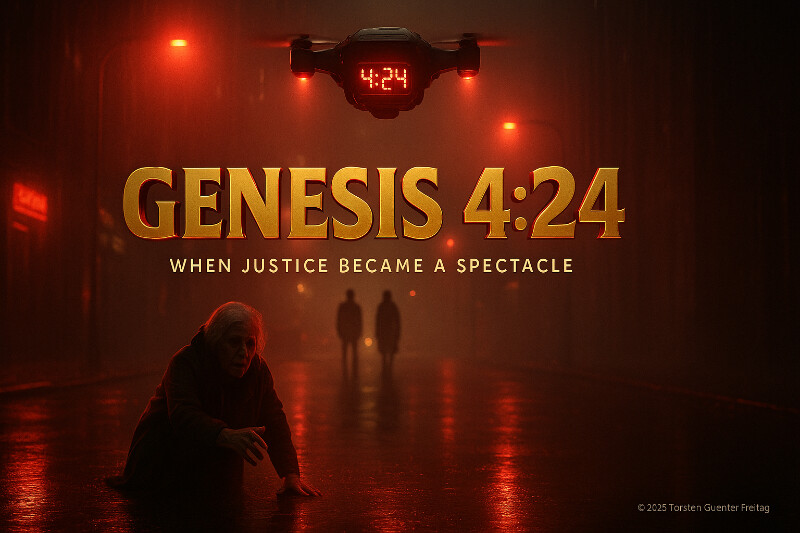
In an era where speculative fiction increasingly serves as cautionary prophecy, Torsten Guenter Freitag’s “GENESIS 4:24” arrives as a chilling meditation on justice, revenge, and the terrifying ease with which societies trade freedom for order. This screenplay—part political thriller, part dystopian nightmare—constructs a 2045 America that feels uncomfortably plausible, where biblical vengeance has been codified into law and public executions have become televised entertainment.
The World of Mirror Justice
The script opens with a America transformed beyond recognition. In 2043, a new president introduced the Federal Mobile Review Court (FMRC)—a “mirror justice” system designed to confront offenders with the consequences of their crimes in brutally literal fashion. By 2045, this has escalated into “Genesis 4:24,” a biblically-framed doctrine that turns retributive justice into permanent reality.
Freitag’s world-building is meticulous and unsettling. The opening montage presents a society where teenage graffiti artists watch helplessly as enforcers spray-paint their family homes gray, where environmental polluters are forced to live in their own garbage for a week, and where public disrespect earns immediate public humiliation. Court trucks—sleek, black vehicles emblazoned with “4:24″—roll through the country like harbingers of algorithmic punishment, their presence both omnipresent and inevitable.
The most haunting sequence involves an elderly woman collapsing on a crosswalk. Bystanders freeze, unable to help because she’s under a “contact ban” mirror penalty. A child steps forward; their mother yanks them back. A drone counts down the seconds until assistance is legally permitted. It’s a masterclass in showing how systems of control don’t just punish individuals—they corrupt entire communities, turning compassion itself into a crime.
The Protagonist’s Journey
At the heart of this dystopia is Noah Benton (formerly Ben), a 21-year-old graffiti artist who spray-paints half-finished Liberty Bells across New Washington. His chosen symbol—the cracked bell bearing the inscription “Proclaim liberty throughout the land unto all the inhabitants thereof”—serves as the story’s central metaphor for fractured freedom.
Noah’s backstory, revealed through carefully layered flashbacks, adds emotional depth to his rebellion. Orphaned at seven in a car accident, shuttled through four foster families in two years, he reinvented himself as “Noah”—one who doesn’t go under, who makes room in the boat for others. There’s a poignant continuity in how child Noah compulsively turned the wheel of a toy car in foster care, and how adult Noah now turns that same motion in handcuffs during transport. It’s a subtle gesture that speaks volumes about trauma, resilience, and the psychology of survival.
The romance between Noah and Lena Ortega feels earned rather than forced. Their first meeting—hands touching over a cheap thermos of synthetic coffee, a moment lingering too long—establishes chemistry through small, human moments amid the brutality. When Noah shows Lena his comic book “Escape from Chapter 4:24,” featuring stylized versions of themselves fleeing through an endless labyrinth, it’s both playful and prophetic.
The Stunning Twist
The script’s central revelation arrives with surgical precision at the midpoint: Lena Ortega is actually Lena Caldwell, the adopted daughter of President Caldwell himself, and—in a twist that deepens the thematic resonance—the biological daughter of the story’s true antagonist, Priest Malachai Pierce.
This familial connection transforms what could have been a straightforward resistance narrative into something far more complex. Lena isn’t just fighting against an abstract tyranny; she’s confronting her own father’s complicity and her biological father’s manipulation. The scene where Mia discovers adoption records on a government server—”Biological father: Malachai Pierce Crane. Adoptive parents: Caldwell family”—lands with devastating impact precisely because Freitag has carefully established Lena’s fierce independence and moral clarity.
The flashback to Lena’s transformation eighteen months earlier adds layers to her character. We watch her cut her own hair in a cheap salon, get a new identity from Pixel (a moment where bureaucratic red flags briefly flicker on screen before being overridden), and slowly disappear into the underground resistance. Her mother Evelyn’s secret emails—”Take care of yourself. I love you. Always.”—provide the emotional throughline that makes the third-act revelation resonate.
The Real Villain: Malachai Pierce
While President Caldwell serves as the public face of Genesis 4:24, Priest Malachai Pierce emerges as the story’s true architect of horror. Malachai is a chilling creation—a religious authority who weaponizes faith not out of belief but as “leverage.” His whispering manipulation of the president in the church scene feels genuinely unsettling, less demonic possession than psychological domination.
The revelation of Malachai’s insurance policy is brilliantly conceived: his ornate cross contains a microphone and memory card, recording seven years of cabinet meetings, confessions, and compromising conversations. The detail that every “Amen” triggers an encrypted upload is the kind of specific, believable technological detail that grounds the supernatural trappings in procedural reality. His dead man’s switch—packages ready to release to committees, editorial offices, and law firms the moment his heart stops—makes him seemingly untouchable.
The confrontation between Malachai and Caldwell in the VIP box during the execution sequence is the script’s dramatic apex. When Malachai gloats—”If I fall, your empire falls with me”—and reveals Operation LAMECH/Zero (the judicial murder of Samuel Briggs before Genesis 4:24 officially existed), we understand that the entire system is built on a foundation of recorded blackmail. The president’s attempt to seize the cross, the struggle, and Malachai’s accidental death against the glass edge happens with shocking suddenness—no dramatic speeches, just a brutal crack and sudden stillness.
Dialogue That Cuts
Freitag’s dialogue achieves that rare balance between naturalistic and thematically resonant. Characters speak like real people while articulating the script’s central concerns.
Noah’s defiant statement at his trial—”You call this order? This is not justice—this is fear. Silence means consent.”—becomes the resistance’s rallying cry, spray-painted across the nation. It’s simple, memorable, and philosophically sound.
The president’s interrogation of Noah showcases Freitag’s ability to write compelling philosophical debate without losing dramatic momentum:
PRESIDENT CALDWELL: “Hope is weakness. It blinds people to what is necessary.”
NOAH: “But you’re afraid, aren’t you? Of the future. Of those who are no longer afraid.”
This exchange encapsulates the central conflict: fear-based order versus hope-based resistance. The president’s subsequent monologue—”Fear is justice, Noah. It forces the wicked to fall—and the righteous to be silent”—is the kind of villain speech that works because it contains an uncomfortable grain of truth about how authoritarian systems function.
Malachai’s whispered threats carry genuine menace: “You don’t need a conscience. Just obedience.” There’s something more frightening about quiet manipulation than bombastic villainy.
The most emotionally devastating dialogue comes from Spark, revealed through his conversation with Beth about his girlfriend who received a “non-attention” penalty—six months where no one was legally allowed to look at or speak to her. His broken recollection—”After three weeks she barely spoke. After six she was gone. Silence.”—followed by his confession about being found drunk in a stairwell, having spray-painted “hopeless” crookedly on a wall, provides the emotional foundation for understanding why ordinary people risk everything to resist.
The Writer’s Perspective
Reading through Freitag’s screenplay, a distinctive authorial worldview emerges—one shaped by deep concern about the intersection of religion, politics, and retributive justice.
Fear of Theocratic Authoritarianism: The script’s most sustained anxiety revolves around religious rhetoric being weaponized to justify state violence. Genesis 4:24’s biblical framing—”If Cain is avenged sevenfold, Lamech will be avenged seventy-sevenfold”—transforms ancient scripture into modern policy. But crucially, Freitag doesn’t present this as genuine faith.
Malachai explicitly states: “The bishops can call it God’s justice all they want. It fills their pews. For me it’s leverage.” This suggests the writer’s concern isn’t with religion per se, but with its cynical deployment as a control mechanism.
Critique of Punitive Justice: The “mirror punishment” concept serves as an exaggerated critique of retributive justice systems. By literalizing “an eye for an eye”—polluters living in trash, graffiti artists watching their homes be defaced, people sentenced to enforced invisibility—Freitag exposes the philosophical emptiness of purely punitive approaches.
The question implicit throughout: if punishment only creates more suffering without rehabilitation or restoration, what purpose does it serve beyond satisfying vengeance?
Media Complicity: The script is deeply concerned with how spectacle normalizes atrocity. The arena execution isn’t just punishment; it’s entertainment, complete with pre-game shows, commentary, and livestream viewer counts (“2.1 MILLION”). The TV news montage shows different channels competing to frame Noah’s arrest as heroic police work, with one YouTuber ironically joking about “a new season of ‘Noah Goes Under.'” The classroom scene where children eagerly volunteer to describe punishments (“the right hand is cut off!”) reveals how quickly brutality becomes pedagogy. Freitag seems particularly troubled by collective desensitization—the process by which societies come to accept the unacceptable through repetition and presentation.
Family as Resistance: Against institutional horror, Freitag places family bonds—both biological and chosen. Evelyn’s love for Lena transcends political loyalty. Noah’s chosen name and found family with the resistance offers an alternative to the biological family he lost. Even Beth’s tragedy stems from love for her parents. The script suggests that intimate human connection remains the primary bulwark against dehumanizing systems.
Skepticism About Reform: The epilogue is telling in its ambiguity. President Caldwell is impeached, Torres takes office speaking of “healing” and “rule of law,” but the script notes: “The United States is reeling into chaos. New elections are imminent.” There’s no triumphant restoration of democracy, no clear suggestion that Torres represents genuine reform rather than merely competent managerial authoritarianism. The resistance doesn’t stay to rebuild; they flee to Rome. This suggests Freitag’s skepticism about whether systems this corrupted can be reformed from within, or whether survival sometimes means escape.
Hope as Praxis: Despite the darkness, the script isn’t nihilistic. Noah’s art—the half-finished Liberty Bells appearing across the nation—represents hope as active practice rather than passive feeling. When Lena asks if Noah’s comic book characters will find their way out of the labyrinth, he responds: “Let’s see what the next chapter brings.” Hope here isn’t certainty; it’s continuation, the refusal to accept that the current chapter is the final one.
Cinematic Potential
As a film property, “GENESIS 4:24” offers considerable commercial and artistic appeal:
Timely Themes: Stories about surveillance states, religious extremism, and punitive justice resonate strongly with contemporary anxieties. The script’s exploration of how societies trade freedom for security feels particularly relevant.
Visual Distinctiveness: The court trucks, the gray paint sequences, the arena execution, and the omnipresent drones create a specific visual language. A talented production designer could make this world feel both futuristic and uncomfortably recognizable.
Strong Central Relationship: Noah and Lena’s romance, grounded in shared resistance rather than romantic convention, provides emotional accessibility without undermining the political thriller elements.
Ensemble Cast: While the leads carry the narrative, the script offers meaty supporting roles—Evelyn’s quiet anguish, Spark’s tragic optimism, Beth’s conflicted betrayal, Malachai’s cold manipulation—that could attract quality actors.
Action Sequences: The opening chase, the raid on the hideout, and the arena climax provide set-piece opportunities while serving story rather than existing merely as spectacle.
International Appeal: While the setting is specifically American, the themes of authoritarianism, resistance, and hope transcend national context. The decision to end in Rome suggests the story’s universality.
“GENESIS 4:24” is an ambitious, thoughtful, and often harrowing piece of speculative political fiction. Freitag has crafted a world that feels coherent, characters whose choices matter, and themes that resonate beyond genre convention.
The script’s greatest strength lies in its willingness to follow its premise to uncomfortable conclusions. Lesser writers might soften the edges, provide easier redemptions, or guarantee satisfying victory. Freitag instead presents a world where good people make desperate choices (Beth’s betrayal), where resistance comes at terrible cost (Spark’s death), and where escape rather than triumph sometimes represents the only viable ending.
The relationship between Noah and Lena provides genuine emotional stakes without becoming maudlin. Their connection feels earned through shared values and complementary traumas rather than mere attraction. When they kiss briefly in the arena chaos—”I couldn’t have borne losing you”—it works because Freitag has shown us why they matter to each other.
The script’s moral complexity elevates it above simple resistance narrative. President Caldwell isn’t a cartoon villain; his interrogation of Noah reveals a man who genuinely believes fear-based order serves the greater good. Malachai’s manipulation of religious authority for power feels more frightening than outright evil because it’s recognizable. Beth’s coerced betrayal asks difficult questions about culpability under duress.
If the third act occasionally buckles under the weight of its ambitions, and if some supporting characters could use deeper development, these are refinable issues rather than fatal flaws. The core narrative—artist becomes symbol, symbol becomes movement, movement forces reckoning—remains sound.
For viewers willing to engage with challenging political ideas dressed in thriller conventions, “GENESIS 4:24” offers both entertainment and provocation. It asks whether justice can exist in systems built on vengeance, whether freedom can survive populations willing to trade it for security, and whether hope remains possible when institutions of power corrupt even the symbols of resistance.
The final image—a cargo ship disappearing into fog, carrying five refugees toward uncertain future—refuses easy answers. But in Noah’s hand rests Beth’s Liberty Bell pendant, and somewhere in America, half-finished bells still mark the walls, waiting for someone to complete them.
That seems to be Freitag’s final statement: the work of freedom is never finished, the bell never fully restored, but the cracks themselves can become the most honest symbol—acknowledgment that liberty, once broken, remains forever fractured, requiring constant attention, constant resistance, constant hope that the next chapter might bring something better than this one.
Rating: 8/10 – A powerful dystopian thriller with strong thematic coherence, compelling characters, and urgent contemporary relevance, though occasionally overreaching in ambition and requiring some structural refinement.
Related Posts

Official Jury Review: When Life Gives You Lemons…Everyone’s Everest
Director: Tom McShane When Life Gives You Lemons… Everyone's Everest…

Official Jury Review : Rathill
Directed by Charles A. Christman III There is something admirable…

Official Jury Review- GORDON: THE ROAD TO KHARTOUM
Winner in the Best Feature Script Some historical dramas recreate…